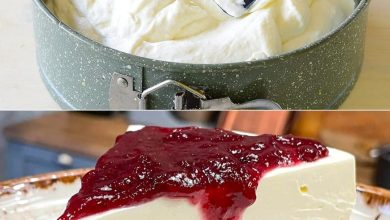
Cherry Cheesecake Dessert
Ingredients:
- For the Crust:
- 2 cups graham cracker crumbs
- 1/2 cup unsalted butter, melted
- 1/4 cup granulated sugar
- For the Cheesecake Layer:
- 2 cups heavy whipping cream
- 1/2 cup powdered sugar
- 1 teaspoon vanilla extract
- 16 oz (450 g) cream cheese, softened
- 1/2 cup granulated sugar
- For the Cherry Topping:
- 1 can (21 oz/595 g) cherry pie filling
- Fresh cherries for garnish (optional)
- Crushed nuts or cookie crumbs for garnish (optional)
Instructions:
- Prepare the Crust:
- In a medium bowl, combine the graham cracker crumbs, melted butter, and granulated sugar. Mix until well combined.
- Press the mixture firmly into the bottom of a 9×13-inch (23×33 cm) baking dish. Refrigerate while preparing the cheesecake layer.
- Prepare the Cheesecake Layer:
- In a large mixing bowl, beat the heavy whipping cream, powdered sugar, and vanilla extract until stiff peaks form. Set aside.
- In another bowl, beat the softened cream cheese and granulated sugar until smooth and creamy.
- Gently fold the whipped cream mixture into the cream cheese mixture until well combined and smooth.
- Spread the cheesecake mixture evenly over the prepared crust.
- Add the Cherry Topping:
- Spread the cherry pie filling evenly over the cheesecake layer.
- Garnish with fresh cherries and crushed nuts or cookie crumbs if desired.
- Chill and Serve:
- Refrigerate the dessert for at least 4 hours, or overnight, to allow it to set.
- Slice into squares and serve chilled
-
The Dot Puzzle: A Simple Test or a Tricky Trap? Puzzles and brain teasers have always been a popular way to challenge our minds and keep us sharp. One such puzzle that has been making rounds on social media is the “How Many Dots?” challenge, accompanied by the bold claim that “99% will fail.” At first glance, this puzzle appears straightforward, but its simplicity is exactly what makes it so tricky. The Puzzle Breakdown The puzzle presents a pattern of green dots arranged in a cross formation, with a prompt asking the viewer to count the total number of dots. While it seems like a simple task, many people are surprised to find that their initial answer is often incorrect. The dots are arranged in a grid, with each arm of the cross containing three rows of three dots. The challenge lies in the visual perception and the tendency to overlook some dots or double count others due to the pattern. The Psychology Behind the Puzzle What makes this puzzle challenging is a phenomenon known as “cognitive overload.” When presented with a repetitive pattern, our brains can easily get confused, leading us to either skip over some dots or count them multiple times. The symmetry of the dots also plays a role, as our brains are wired to quickly recognize patterns and sometimes make assumptions based on those patterns. Another factor at play is the “anchoring effect,” where our initial guess tends to influence our final answer, even if we realize there might be an error. If someone quickly counts and gets an answer like 20, they might be less likely to recount carefully because they’ve already anchored themselves to that number. The Correct Answer To solve the puzzle correctly, it’s essential to approach it methodically. Start by counting each row and column carefully, ensuring that no dots are missed or counted twice. The puzzle contains a total of 25 dots. Here’s how the dots are arranged: The vertical line of the cross has 5 dots. The horizontal line of the cross has 5 dots. Each arm of the cross (including the center dot) intersects with the others, making sure that dots are not double-counted. Why This Puzzle Is Popular The allure of this puzzle lies in its simplicity. It doesn’t require advanced mathematical skills or deep thinking—just careful observation. However, the claim that “99% will fail” taps into our competitive nature, encouraging us to prove that we are among the 1% who can solve it correctly. Moreover, such puzzles are a form of social engagement. People enjoy sharing their answers and comparing them with friends, leading to discussions and debates about the correct solution. It’s a fun way to engage with others while also giving your brain a quick workout. Conclusion The “How Many Dots?” puzzle is a classic example of how even the simplest tasks can become challenging under the right conditions. It teaches us the importance of careful observation and the pitfalls of making quick judgments. So, the next time you encounter a puzzle like this, take a deep breath, focus, and count those dots with care—you might just surprise yourself! This article provides an analysis of the puzzle, explaining why it can be challenging and how to approach solving it correctly. It also delves into the psychological aspects that make such puzzles intriguing and popular.
September 3, 2024
Back to top button