ADVERTISEMENT
Lemon Meringue Pie
Introduction
There is something truly special about a homemade Lemon Meringue Pie. With its golden, flaky pastry crust, smooth and tangy lemon filling, and beautifully toasted clouds of fluffy meringue, this classic dessert brings together an irresistible combination of flavors and textures.
Every slice offers the perfect balance of sweetness and refreshing citrus flavor. The bright yellow lemon filling is rich, silky, and bursting with fresh lemon goodness, while the light, airy meringue adds a delicate sweetness that melts beautifully in your mouth.
This timeless dessert has been a favorite in home kitchens for generations. Whether served at a holiday celebration, a family gathering, a Sunday dinner, or a special afternoon occasion, Lemon Meringue Pie always makes a beautiful centerpiece.
One of the most wonderful things about this recipe is the contrast between its three delicious layers. The buttery pastry provides a crisp foundation, the homemade lemon filling adds a creamy and refreshing center, and the golden meringue creates an elegant, cloud-like topping.
Although Lemon Meringue Pie may look like a complicated bakery dessert, it is surprisingly manageable when prepared step by step. With fresh ingredients, a little patience, and a few simple baking techniques, you can create a beautiful homemade pie that tastes just as wonderful as it looks.
ADVERTISEMENT
If you love classic desserts with bright citrus flavor and a soft, creamy texture, this homemade Lemon Meringue Pie is sure to become one of your favorites.
Ingredients
For the Pie Crust
1 (9-inch) pie crust, fully baked and cooled
You can use a homemade buttery pastry crust or a prepared store-bought pie crust.
For the Lemon Filling
1 cup (200 g) granulated sugar
1/4 cup (32 g) cornstarch
ADVERTISEMENT
1 1/2 cups (360 ml) water
1/2 cup (120 ml) freshly squeezed lemon juice
1 tablespoon finely grated lemon zest
4 large egg yolks, lightly beaten
2 tablespoons (28 g) unsalted butter
ADVERTISEMENT
1 teaspoon vanilla extract
Pinch of salt
For the Meringue Topping
4 large egg whites, at room temperature
1/2 cup (100 g) granulated sugar
1/4 teaspoon cream of tartar
ADVERTISEMENT
Pinch of salt
Optional Garnishes
Fresh lemon zest
Thin lemon slices
A light dusting of powdered sugar
Fresh mint leaves
Preparation Instructions
Step 1: Prepare the Pie Crust
Begin by preheating your oven to 375°F (190°C), or according to the instructions for your chosen pie crust.
If using homemade pastry dough, roll it out on a lightly floured surface until it is large enough to fit a 9-inch pie dish.
Carefully transfer the dough into the pie dish, pressing it gently against the bottom and sides.
Trim any excess dough and crimp the edges for a decorative finish.
ADVERTISEMENT
Prick the bottom lightly with a fork, line the crust with parchment paper, and fill it with pie weights or dried beans.
Bake for approximately 15 minutes, then carefully remove the weights and parchment.
Continue baking for another 10–15 minutes, or until the crust is golden brown and fully cooked.
Allow the crust to cool while preparing the lemon filling.
If using a store-bought crust, follow the package instructions for blind baking.
Step 2: Prepare the Fresh Lemons
Wash the lemons thoroughly under cool running water.
Using a fine grater or citrus zester, remove approximately 1 tablespoon of lemon zest.
Be careful to grate only the yellow outer layer, avoiding the bitter white pith underneath.
Cut the lemons in half and squeeze out the juice.
Measure 1/2 cup of fresh lemon juice.
Remove any seeds before using.
Fresh lemon juice is especially important because it gives the pie its bright, refreshing flavor.
Step 3: Combine the Sugar and Cornstarch
In a medium saucepan, combine the granulated sugar, cornstarch, and a pinch of salt.
Whisk thoroughly until the dry ingredients are evenly mixed.
This step helps prevent lumps from forming when the liquid is added.
The cornstarch is responsible for thickening the lemon filling and creating its smooth, sliceable consistency.
Step 4: Add the Water
Slowly pour the water into the saucepan while whisking continuously.
Continue whisking until the sugar and cornstarch are fully dissolved.
Place the saucepan over medium heat.
Cook the mixture while stirring constantly with a whisk or silicone spatula.
After several minutes, the mixture will begin to thicken and turn glossy.
Once it reaches a gentle boil, continue cooking for approximately 1 minute while stirring.
This helps activate the cornstarch and gives the filling its proper thickness.
Step 5: Temper the Egg Yolks
Place the lightly beaten egg yolks in a separate heat-resistant bowl.
Slowly add approximately 1/2 cup of the hot sugar mixture to the egg yolks, whisking constantly.
This process is called tempering.
It gradually raises the temperature of the egg yolks and prevents them from scrambling when added to the hot filling.
Once combined, slowly pour the tempered egg yolk mixture back into the saucepan.
Whisk continuously until everything is smooth.
Step 6: Cook the Lemon Filling
Return the saucepan to medium-low heat.
Continue cooking while stirring constantly until the mixture becomes thick, smooth, and glossy.
Bring it to a gentle bubble and cook for approximately 1 minute, ensuring the egg yolks are fully cooked.
Remove the saucepan from the heat.
Stir in the freshly squeezed lemon juice, lemon zest, unsalted butter, and vanilla extract.
Continue stirring until the butter melts completely and the filling becomes silky and smooth.
The finished lemon filling should have a beautiful golden-yellow color and a rich, tangy aroma.
Step 7: Fill the Baked Pie Crust
Place the fully baked pie crust on a heat-resistant surface.
Carefully pour the hot lemon filling into the crust.
Use a spatula to spread the filling evenly and smooth the surface.
The filling should reach close to the top of the crust without overflowing.
Keep the filling warm while preparing the meringue.
Adding the meringue over warm filling helps it adhere more securely and can reduce the chance of a watery layer forming between the filling and topping.
Step 8: Prepare the Egg Whites
Make sure the mixing bowl and beaters are completely clean and free from grease.
Place the room-temperature egg whites in a large mixing bowl.
Add the cream of tartar and a small pinch of salt.
Using an electric hand mixer or stand mixer fitted with a whisk attachment, begin beating the egg whites on medium speed.
Continue until the mixture becomes foamy and begins forming soft peaks.
The cream of tartar helps stabilize the egg whites and creates a more reliable meringue.
Step 9: Gradually Add the Sugar
With the mixer running on medium-high speed, gradually add the granulated sugar, approximately 1 tablespoon at a time.
Continue beating after each addition.
Adding the sugar slowly allows it to dissolve more evenly into the egg whites.
Beat the mixture until it becomes thick, glossy, and forms stiff peaks.
When you lift the beaters, the peaks should stand upright without collapsing.
Rub a small amount of meringue between your fingers. It should feel smooth rather than noticeably grainy.
Avoid overbeating, which can make the meringue dry and difficult to spread.
Step 10: Spread the Meringue Over the Filling
While the lemon filling is still warm, spoon the prepared meringue over the surface.
Begin by spreading the meringue around the edges of the pie.
Make sure it touches and seals against the pastry crust all the way around.
This is an important step because it helps prevent the meringue from shrinking during baking.
Once the edges are sealed, spread the remaining meringue across the center.
Use the back of a spoon or spatula to create decorative swirls and soft peaks.
These peaks will develop beautiful golden tips during baking.
Step 11: Bake the Meringue
Reduce the oven temperature to 350°F (175°C).
Place the assembled pie on the center rack.
Bake for approximately 12–15 minutes, or until the meringue is lightly golden and the peaks have developed a beautiful toasted appearance.
For food safety, the center of the meringue should reach 160°F (71°C). Check with an instant-read thermometer without touching the hot lemon filling beneath.
If the top browns before the meringue reaches the proper temperature, loosely shield the browned areas with foil.
Watch the pie carefully near the end of baking because the meringue can brown quickly.
The finished topping should look fluffy, glossy, and lightly toasted.
Step 12: Cool the Pie
Remove the pie from the oven and place it on a wire cooling rack.
Allow it to cool at room temperature for approximately 1 hour.
During this time, the lemon filling will begin to firm up.
Avoid cutting the pie while it is hot because the filling may be too soft to hold its shape.
Once the pie has cooled slightly, transfer it to the refrigerator.
Step 13: Chill Until Set
Refrigerate the pie for approximately 3–4 hours, or until the lemon filling is completely chilled and firm enough to slice.
Chilling is essential for achieving clean, attractive slices.
The lemon filling will continue to set as it cools, creating the smooth and creamy texture that makes Lemon Meringue Pie so delicious.
For the best presentation, avoid covering the meringue tightly while it is still warm.
Step 14: Slice and Serve
When ready to serve, remove the pie from the refrigerator.
Use a sharp knife to cut it into individual slices.
For cleaner slices, dip the knife into warm water and wipe it dry between cuts.
Carefully transfer each slice to a dessert plate.
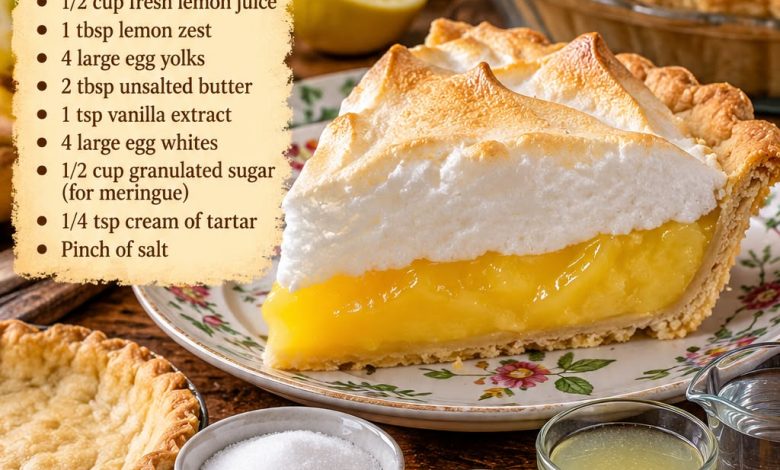
The finished pie should have three beautiful layers: a golden pastry crust, a bright yellow lemon filling, and a thick, fluffy meringue topping.
Serve chilled and enjoy the wonderful combination of sweet, tangy, creamy, and crisp textures.
Helpful Tips for Perfect Lemon Meringue Pie
1. Always use fresh lemon juice.
Freshly squeezed lemon juice provides a brighter, more natural citrus flavor than bottled juice.
2. Measure the cornstarch carefully.
Cornstarch gives the lemon filling its structure. Too little may produce a runny filling, while too much can make it overly firm.
3. Temper the egg yolks slowly.
Adding the hot mixture gradually prevents the egg yolks from scrambling.
4. Use room-temperature egg whites.
Room-temperature egg whites generally whip more easily and produce a light, fluffy meringue.
5. Keep the mixing bowl grease-free.
Even a small amount of fat or egg yolk can prevent egg whites from whipping properly.
6. Add the sugar gradually.
Slowly incorporating the sugar helps create a smooth, glossy meringue.
7. Seal the meringue to the crust.
Spreading the meringue all the way to the pastry edges helps reduce shrinking.
8. Spread meringue over warm filling.
Warm filling helps the topping adhere and reduces the chance of separation.
9. Allow enough chilling time.
A properly chilled pie is much easier to slice and serve.
10. Avoid overbaking the meringue.
Excessive baking can cause the topping to dry out or develop moisture droplets.
Delicious Recipe Variations
Extra-Tangy Lemon Meringue Pie
For a stronger lemon flavor, increase the lemon zest to 1 1/2 tablespoons.
This adds more citrus aroma without significantly changing the consistency of the filling.
Meyer Lemon Meringue Pie
Replace regular lemons with Meyer lemons.
Meyer lemons are naturally sweeter and less acidic, creating a softer, more delicate citrus flavor.
Lemon Lime Meringue Pie
Replace 2 tablespoons of the lemon juice with freshly squeezed lime juice.
This variation creates a refreshing combination of lemon and lime flavors.
Lemon Meringue Pie with Graham Cracker Crust
Replace the traditional pastry crust with a fully baked graham cracker crust.
The sweet, buttery graham cracker flavor pairs beautifully with the tangy lemon filling.
Mini Lemon Meringue Pies
Prepare the recipe using small tart pans instead of one large pie dish.
Divide the lemon filling and meringue evenly among the baked tart shells.
Adjust the baking time according to the size of the individual pies.
These miniature desserts are perfect for parties, celebrations, and dessert tables.
Serving Suggestions
Lemon Meringue Pie is delicious on its own, but a few simple accompaniments can make it even more special.
With fresh berries: Serve each slice with strawberries, raspberries, or blueberries for a colorful presentation.
With hot tea: A warm cup of black tea or herbal tea pairs beautifully with the refreshing lemon flavor.
With coffee: The sweetness of the meringue and tartness of the filling create a wonderful contrast with freshly brewed coffee.
For holiday gatherings: Arrange slices on decorative dessert plates and garnish with a small amount of lemon zest.
For spring celebrations: Serve the pie with fresh berries and mint leaves for a bright, seasonal presentation.
For summer desserts: Enjoy a chilled slice after a family barbecue or outdoor meal.
Storage Instructions
Lemon Meringue Pie is best enjoyed on the day it is prepared because the meringue has its freshest texture and appearance.
However, leftovers can be stored in the refrigerator.
Place the pie in a suitable container or cover it loosely with a protective cover that does not touch the meringue.
Refrigerate at 40°F (4°C) or below.
For the best quality, enjoy within 2–3 days.
The meringue may gradually release moisture during storage, which can slightly affect its appearance and texture.
Freezing Lemon Meringue Pie is not recommended because the meringue can become watery and the lemon filling may lose its smooth consistency after thawing.
Frequently Asked Questions
Why is my lemon filling runny?
A runny filling can result from insufficient cooking, inaccurate cornstarch measurements, or slicing the pie before it has fully chilled.
Why does my meringue shrink?
Meringue may shrink if it is not spread all the way to the edges of the crust. Always seal the topping against the pastry.
Why does my meringue develop water droplets?
This is often called weeping. It can happen when the sugar has not dissolved properly, the meringue is undercooked or overcooked, or moisture develops during storage.
Can I make Lemon Meringue Pie ahead of time?
Yes. You can prepare it several hours before serving and refrigerate it until fully chilled. For the best meringue texture, it is preferable to serve it the same day.
Can I use bottled lemon juice?
Fresh lemon juice is strongly recommended for the best flavor, although bottled lemon juice can be used when fresh lemons are unavailable.
Can I make this recipe without cream of tartar?
Yes, but cream of tartar helps stabilize the egg whites. A small amount of lemon juice can be used as an alternative.
How do I get beautiful golden meringue peaks?
Use the back of a spoon to create decorative peaks before baking. The raised areas will brown naturally in the oven.
Should Lemon Meringue Pie be served warm or cold?
It is best served chilled because the lemon filling needs time to set properly.
Recipe Information
Preparation Time: 25–30 minutes
Baking Time: 40–45 minutes, including blind baking the crust
Cooling and Chilling Time: Approximately 4–5 hours
Total Time: Approximately 5–6 hours
Servings: 8 slices
Cooking Method: Stovetop and oven-baked
Difficulty Level: Intermediate
Main Ingredients: Lemons, sugar, eggs, cornstarch, butter, and pastry crust
Best Served: Chilled
Conclusion
This Lemon Meringue Pie is a beautiful celebration of classic homemade baking. With its flaky golden crust, smooth and tangy lemon filling, and light, fluffy meringue topping, every slice offers an unforgettable combination of flavors and textures.
What makes this dessert so special is the wonderful balance between sweet and tart. The fresh lemon filling delivers a bright citrus flavor, while the delicate meringue adds just the right amount of sweetness. The buttery pastry crust brings everything together with a satisfying, slightly crisp finish.
Although the finished pie looks elegant and impressive, it can be made at home with simple ingredients and careful preparation. Each step contributes to creating a dessert that is as beautiful as it is delicious.
Whether you’re preparing it for a holiday gathering, a family celebration, a weekend dessert, or simply because you love the refreshing taste of lemons, this homemade pie is sure to bring joy to your table.
Serve it chilled, admire the beautiful golden meringue peaks, and enjoy every sweet and tangy bite.