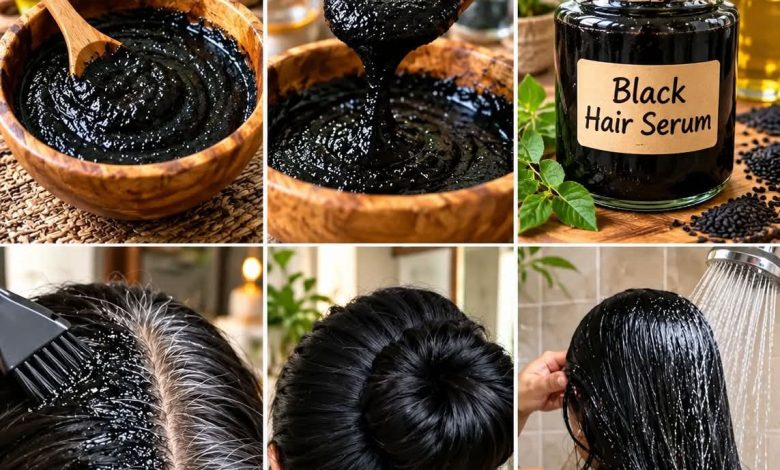
ADVERTISEMENT
Natural Black Hair Dye Recipe – Cover Gray Hair with Henna and Indigo
Looking for a natural way to cover gray hair and achieve a beautiful, rich black color? This traditional two-step hair coloring treatment uses henna and indigo powder to give gray and white strands a darker appearance without conventional permanent hair dyes.
Henna creates a warm reddish base, while indigo adds deep brown-to-black tones. When applied correctly, these two plant-based ingredients can help create a natural-looking dark color with a beautiful shine.
Unlike products that promise to reverse gray hair permanently, this treatment works by coloring the hair rather than restoring its original pigment.
Ingredients
Step 1: Henna Treatment
- 100 grams pure natural henna powder
- Warm water, as needed
- 1 glass or ceramic mixing bowl
- 1 wooden or plastic spoon
Step 2: Indigo Treatment
- 100 grams pure indigo powder (Indigofera tinctoria)
- Lukewarm water, as needed
- A small pinch of salt (optional)
- 1 clean mixing bowl
Additional Supplies
ADVERTISEMENT
- Disposable gloves
- Hair coloring brush
- Shower cap
- Old towel
- Wide-tooth comb
These quantities are generally suitable for short to medium-length hair. Increase the amounts for longer or thicker hair.
Preparation and Application
Step 1: Prepare the Henna Mixture
Place the henna powder in a clean glass or ceramic bowl.
Gradually pour in warm water while stirring continuously until the mixture becomes smooth, creamy, and thick enough to spread easily.
Make sure there are no dry lumps.
Cover the bowl and allow the henna to develop its dye according to the manufacturer’s instructions. The required resting time varies depending on the product and temperature.
ADVERTISEMENT
Avoid adding lemon juice or essential oils, especially if you have a sensitive scalp.
Step 2: Apply Henna to Gray Hair
Start with clean hair that is free from styling products and excessive oil.
Divide your hair into several manageable sections.
Using a coloring brush, apply the henna mixture generously, beginning at the roots where gray hair is most noticeable.
Continue distributing the mixture through the lengths until every strand is completely covered.
ADVERTISEMENT
Pay special attention to the temples, hairline, and crown, where white strands are often more visible.
Cover your hair with a shower cap and leave the mixture on for approximately 1–2 hours, or according to the product instructions.
Rinse thoroughly with lukewarm water.
At this stage, gray hair may appear coppery, orange, or reddish. This is expected because henna creates the base color needed for the next treatment.
Step 3: Prepare the Indigo Mixture
Place the indigo powder in a separate clean bowl.
ADVERTISEMENT
Slowly add lukewarm water and stir until you achieve a smooth, creamy consistency.
If desired, add a small pinch of salt.
Mix thoroughly and use the preparation immediately, since indigo can lose some of its coloring effectiveness after prolonged exposure to water and air.
Step 4: Apply Indigo for a Dark Black Finish
Once the henna has been rinsed out, gently towel-dry your hair.
Divide it into sections again.
Apply the freshly prepared indigo mixture evenly from roots to ends, ensuring complete coverage of all gray and white strands.
Massage the mixture gently through the hair using gloved hands.
Cover your hair with a shower cap and leave the indigo on for approximately 1–2 hours, following the manufacturer’s directions and your strand-test results.
Rinse thoroughly with lukewarm water until the water runs clear.
ADVERTISEMENT
The resulting color may initially appear dark brown, black, or slightly bluish. It can continue developing over the following 24–48 hours.
What Results Can You Expect?
After completing both treatments, many people notice that their gray strands appear significantly darker.
The final shade depends on your natural hair color, the percentage of gray hair, hair porosity, previous coloring treatments, and the quality of the henna and indigo.
Some people achieve a deep black appearance after one complete treatment, while others obtain a softer dark brown shade.
Results vary, and complete gray coverage cannot be guaranteed.
Helpful Tips for Beautiful Results
1. Choose pure ingredients. Use authentic henna and indigo powders without unnecessary additives. Avoid products marketed as “black henna” that may contain the strong allergen PPD.
2. Perform a patch test. Follow the manufacturer’s allergy-testing instructions before applying the products, even if you have used plant-based dyes previously.
3. Test a small strand first. This helps determine how your hair responds and what final color you can expect.
4. Protect your skin and clothing. Henna and indigo can stain towels, clothing, and skin.
5. Avoid irritated skin. Never apply the mixtures to a damaged, inflamed, or irritated scalp.
6. Maintain the color gently. Wash with a mild shampoo and avoid excessive heat styling to help preserve your hair’s appearance.
7. Touch up new growth. As new gray hair appears at the roots, you can repeat the coloring process where needed rather than automatically treating the entire length.
How Long Does the Color Last?
Henna and indigo can provide relatively long-lasting color, but the results are not identical for everyone.
The shade may gradually fade with repeated washing, and new gray roots will become visible as the hair grows.
Touch-up frequency depends on your individual hair growth and how well the color holds.
Important Note
This is a natural hair-coloring treatment, not a scientifically proven cure for gray hair. It does not permanently reverse the biological process responsible for graying.
Even natural ingredients can cause allergic reactions, so proper testing and careful application are essential.
Final Thoughts
Beautiful dark hair doesn’t always require conventional chemical dyes. With pure henna, quality indigo powder, and a little patience, you can create a rich, naturally inspired dark shade while covering visible gray strands.
The secret is using the right ingredients, following the two-step application carefully, and allowing the color enough time to develop.
Would you try this traditional henna and indigo treatment to cover gray hair naturally?